
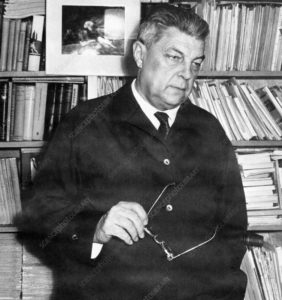
Ivan Antonovich Yefremov (1907-1972), Soviet palaeontologist and science fiction author. Yefremov founded the science of taphonomy, the study of the fate of dead organisms in the geosphere and biosphere. He won the USSR State Prize for this work. His most famous novel was ^IAndromeda Nebula^i (1957). Photographed in 1968, in Russia.
On pages 77–78 in the novel there are two paragraphs in which Darr Veter considers a dinosaur skeleton. Why is this passage significant? Interpret this passage by analyzing what you feel are important details in the text, and by contextualizing the passage within what you now know about Soviet culture, Socialist Realism, or science fiction.
[Response to Andromeda Prompt 3, re: dinosaur skeleton] As Csicsery-Ronay discusses in “SF and the Thaw,” the Thaw and the campaign against socialist realism that followed allowed room in literature for the presence of “sincerity” and personality and the introduction of personal hope through the humanizing (and by extension, personalizing) of science. The significance of a passage in Andromeda to me is that Yefremov, apart from being a writer, was himself a paleontologist. The presence of a relic of Yefremov’s work is a making personal of science, and the in-depth description of the bones in the text shows clear signs of a kind of real appreciation. Despite the many aspects of Andromeda which do align with socialist realist sf, i.e. didacticism, collective protagonists, emphasis on science and materialism, this one passage is especially interesting because it violates socialist realism’s cardinal rule: it discusses history. It dares to mention that precious man, in its glorious humanity, evolved from “clumsy, heavy” creatures (Yefremov 77). Though the Soviet New Man, as discussed in the Gomel reading, is something that was largely developed following the publication and widespread success of Andromeda, socialist realism did still place an emphasis on the idealization of humanity, and so it is shocking and interesting that Yefremov would include this. To include at all, let alone emphasize, the existence and sentience of a living creature that is non-human is incredibly anomalous in this period. It makes sense then to me how Thaw sf is classified as the middle zone between opposition and conformity, and why Andromeda is viewed as the founding text of this period – this passage embodies that. Yefremov, in writing a stereotypical socialist realist text but sprinkling in just a hint of something personal, a small callback to history, is tiptoeing the line of what is accepted and what is forbidden. This novel is a strange kind of paradox, a marriage of things that don’t quite match, much like the Soviet New Man. Andromeda celebrates man’s achievements and the immortality of knowledge, yet highlights the inherent danger of man’s Icarus complex in relation to science, and the kind of existential futility that comes with mortality. It has the timeless-present (rooted in the temporal unknown) quality of socialist realism, yet makes allusion to real history, almost laughing in the face of the state’s conventions. Immediately after the discussion of dinosaurs, Yefremov is smart to relate it to the biological superiority of Veda, linking the evolution over time as a kind of natural eugenics. This passage toes an important line, exists in a transitory period of Soviet history, and embodies as a whole how the novel too exists in that period.